ABOUT:
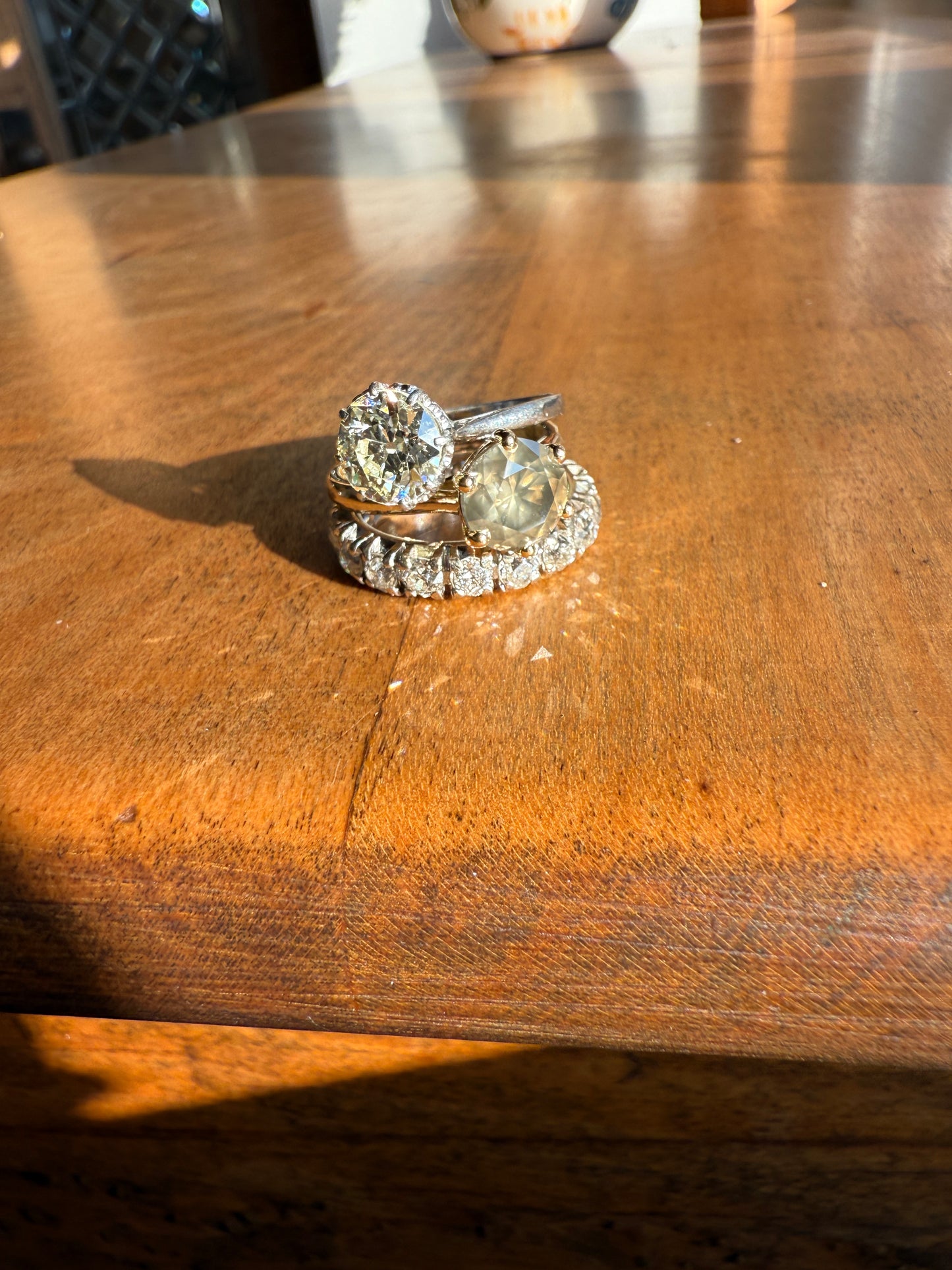
Edwardian Perfection! I love the mouth watering hue to this gorgeous, eye clean old European cut diamond. All original antique stone in its platinum setting from the early 1900s. The sturdy setting which is ready for regular wear has little arched details between each prong to add interest from the side, almost resembling little hearts or architectural details. It just contributes a touch of ornateness to the crown like basket setting.
I like the decision to set the piece in a white metal as it provides contrast to accent the delicious color of the stone. The piece has a faint PLAT stamp inside for platinum, and an old serial number stamp inside one shoulder.
A sparkly and bright little ray of subtle sunshine - as the reads with a touch of yellow in ambient light and then lights up brighter in direct sun. I love antique diamonds like these and they are appropriate for the period as well, have been cut during a period when the mines produced warm rough stones.
Antique box is not included. Please note the measurements as I have small fingers and the pictures can make it difficult to see scale.
SIZE & MEASUREMENTS:
Size 7, slightly over.
The diamond is about 8mm cushion cut and measures about 2 carats I don't remove diamonds from their antique settings for fear of damage (the Four C's scale doesn't apply well to antique stones anyway) so this is an estimated measurement of the stone while set.
The piece weighs 3 grams. It stands 6.8mm off the finger.
IMPORTANT CONDITION NOTES:
I noticed on some of the sunny pics a bit of a speckle, this is no longer present. There was a bit of a smudge on the underside of the diamond - it is completely eye clean.
The prongs encircle the stone on all sides and it is ready for regular wear. The diamond is completely eye clean with nothing really notable even under strong magnification. There is an indented natural inclusion at one spot in the girdle, that appears as an unpolished spot, but as is appropriate for the antique stone, the girdle is frosted (bruted) so the indented natural has less frost than the wide girdle itself. GIA defines an indented natural inclusion as a dent that occurs under the surface of a diamond as a result of the diamond cutter's decision not to polish it off, because doing so could end up harming the diamond so the cutters would work around it - this is not considered a defect or blemish but is a characteristic of the stone.
The diamond seems to vary in hue based on the lighting. It isn't a vibrant yellow so in ambient light, it appears as a slight warmth. The yellow hue brightens in sunlight, what a wonderful stone! Hopefully the pictures in various lighting conditions help to display how the piece wears.
I don't prefer to grade my antique diamonds with the Four C's grading scale which came about way later for machine cut diamonds with mathematically perfected facets. The scale does not do antique stones justice as they were expertly hand cut to their best advantage, in a much more limited supply compared to the millions of carats of machine cut diamonds made each year now. Their uniqueness and quirks are expected and part of their charm, but I will pass along the grades as I received them of M/N in color and VS2 in clarity. My items do very well without paperwork as I describe everything in detail so there are never any surprises, so there is no certification included. But this is a correct and period appropriate antique ring in pretty much every way which we love to find!
Please note that all my pieces are pre-owned and in estate condition. They will have patina, surface wear, a few small nicks. These pieces may also have evidence of a sizing, some build up around the stones and / or inclusions seen under magnification, typical for antique pieces. I have mentioned any noticeable issues above and they are all still wearable and eager to be loved and accepted for many years to come, (the preservation of antique jewelry, even those with signs of their age and history, is important to me. : )
But - Please note due to age, this piece is not in mint condition. Pictures also serve as part of the description and condition report so please utilize the zoom feature which will magnify any wear significantly more than what is visible to the eye while wearing : )
I enjoy making my customers happy and matching unique pieces with new homes. Please feel free to reach out to me with any questions! It means a lot to me that you are visiting my shop! : )
SOCIAL:
Please feel free watch @mouseshouseantiques on Instagram for inventory drops, sneak peaks and previews! And check out my website www.MousesHouseAntiques.com as I can add more pics there so you can get extra looks : )
All items hand picked by me, one at a time from all over the world. All listings individually written by me, and not AI, after studying each piece to discuss its beauties and its ; ) eccentricities (which I am picky to point out).
More notes about antique diamonds:
The whole "4 C's" of cut, color, clarity, carat didn't come about until the 1940s so prior to that and especially on antique pieces, there was not emphasis placed on those things. (Sure people probably appreciated a certain look of a certain diamond as it appeared to the eye but it was not a graded scale like we have today for machine cut stones.) It is difficult to judge antique stones against modern day diamonds with their grading system evaluating their mathematically perfected proportions using methods and standards that didn’t exist for hand cut old cut diamonds. No two old cuts are the same as they were crafted in times lacking those modern standards. The diamond cutters of the time were experts at hand cutting each stone to enhance it which means that even lower color grades can be cut to appear whiter. (Although it is also worth noting that many antique collectors prefer and seek out antique diamonds with warmer hues.)
It is also interesting that "lower graded" diamonds in today's scale system, were some of the best on the market during the antique period! So it is less about their grades and more about the unique play of light and color that each one can offer. As one of many articles puts it: “When searching for the perfect old cut diamond (for you), you need to view them through different eyes as you would for a modern diamond, Laboratory grading reports don’t offer too much information in regards to their individual beauty or sparkle which are based more on their individual character and uniqueness that each one potentially offers.”
As another example, I recently purchased a ring for my own collection that prior to me buying, had had the stone removed from the antique setting. Removing it broke the basket setting and chipped the stone so for me personally, I dearly wish they would have sold it to me without the paperwork, this is me speaking as a buyer in addition to being a seller. Of course everyone is entitled to their own wonderful opinions but this is just one other perspective / point of view. : )
Box#@m.262